The Loss of Agricultural Land in Puerto Rico: Between Construction and Food Security (English Version)
Puerto Rico is facing a critical situation regarding the use of its agricultural land. What was once a predominantly agricultural island is now confronted with the reality that a large portion of its fertile soil has been converted into housing developments, shopping centers, and highways. This situation not only represents a transformation of the landscape but also poses a direct threat to the island’s food security and economic future.
The Decline of Agricultural Land in Puerto Rico
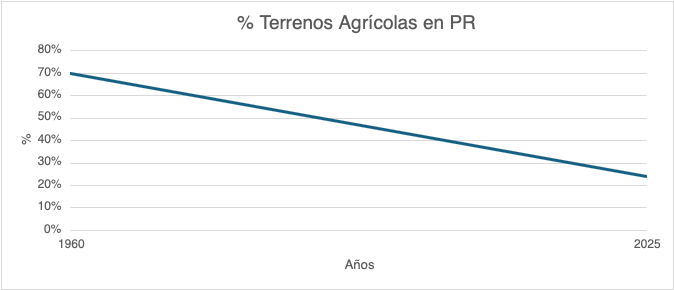
In the 1960s, over 70% of Puerto Rico’s territory was dedicated to agriculture. Today, less than 24% of the island is classified as agricultural land, according to estimates from the Department of Agriculture and the Puerto Rico Institute of Statistics. This is a very unfortunate reality—what remains of agricultural land is nearly one-third of what we once had.
Each year, thousands of acres of fertile land, many among the most productive in the Caribbean, are converted into residential or commercial developments. This constant reduction undermines Puerto Rico’s ability to produce food locally and forces the island to rely even more heavily on imports.
Causes of the Loss of Agricultural Land
Rapid Urbanization: Population growth in urban and suburban areas has displaced farmland to make way for housing developments and highways.
Lack of Land-Use Planning: The absence of clear policies to protect agricultural soils makes it easier for them to be converted to non-agricultural uses.
Farm Abandonment: The lack of incentives, limited profitability, and the migration of farmers have led many landowners to sell or lease their land for construction purposes.
Shift in Economic Structure: The transition from an agricultural-based economy to a service-oriented one has pushed agriculture and land use to the background.

Impacts on Agriculture and the Economy
Dependence on Imports: Puerto Rico already imports around 85% of the food it consumes. The loss of agricultural land further worsens this dependency.
Increase in Food Prices: Lower local production means greater vulnerability to international costs and supply chain disruptions. This results in higher food prices for consumers.
Cultural and Heritage Loss: Agriculture is not only an economic activity, but also a reflection of Puerto Rican tradition and identity.
Fewer Economic Opportunities: The reduction of agricultural land limits job potential in the sector and hinders innovative initiatives such as agritourism and organic farming.
Visible Examples of Land Transformation
In southern areas such as Santa Isabel and Juana Díaz, lands historically known for their vegetable production have given way to construction projects for various businesses and companies. In the north, areas near the PR-22 expressway have seen agricultural soils transformed into industrial and residential centers. These examples show how the lack of land-use control and planning has gradually eroded the island’s agricultural foundation—what is most important to us is slowly disappearing.
Solutions and Proposals
- Protected Agricultural Zones: Designate high-value agricultural soils as non-developable through legislation essentially granting stronger legal protection to these lands so they cannot be easily sold or repurposed for other uses such as commercial or industrial construction.
- Direct Incentives for Farmers: Provide financial and tax support to those who keep their land actively engaged in agricultural production.
- Effective Land Use Planning: Establish a clear public policy that restricts the reclassification of agricultural land for non agricultural uses.
- Sustainable Mixed Use Development: Promote projects that combine agriculture, conservation, and agritourism to make the land profitable without compromising its agricultural purpose.
Conclusion
The loss of agricultural land in Puerto Rico is more than just a land use issue it is a threat to food security, economic stability, and national sovereignty. We could be left with a Puerto Rico without agriculture, paying significantly more for food simply because we no longer produce it on the island. If concrete measures are not taken, the island will continue to sacrifice its ability to feed itself in exchange for an unsustainable model of urban development. This would trigger a crisis on multiple fronts it’s not just about agriculture; the consequences reach far beyond. Protecting agricultural land is not optional it is an urgent necessity to ensure Puerto Rico’s future.
The Official Sponsor of this article is:
De Mi Tierra a Mi Pueblo Corp. 🌱 Committed to Agriculture and Food Security in Puerto Rico.
References
- Departamento de Agricultura de Puerto Rico. Estadísticas Agrícolas.
- Instituto de Estadísticas de Puerto Rico. Uso de terrenos y planificación territorial.
- Food and Agriculture Organization (FAO). Land use and food security in the Caribbean.
September 4, 2025
 Economía y Agricultura en Puerto Rico - Eduardo Bonilla