Agrotechnology: from the machete to the drone in Puerto Rican agriculture (English Version)
Agricultural modernization ceased to be a luxury long ago and has become a requirement: hurricanes, droughts, and labor shortages force farms to produce with greater precision and resilience. In Puerto Rico, the technological need is already clear hydroponics, controlled environment greenhouses, efficient irrigation, and the use of drones show a possible path to compete and produce steadily. Furthermore, the demographic profile of farmers highlights the urgency of attracting new generations to the field: the average age of the principal operator was 60.6 years in 2018, according to the Puerto Rico Census of Agriculture.

Hydroponics: producing more with less land
Hydroponics makes it possible to grow without the need for soil, using nutrient solutions, and is especially useful where fertile soils are scarce or fragmented. On the island, the most visible case is Campo Caribe, a hydroponic lettuce project in Barranquitas that operates in a 5.5 acre state of the art greenhouse; industry sources describe it as the largest hydroponic greenhouse in the Caribbean and one of the few in the world that combines a Cravo retractable roof with deep water culture (DWC).
Drones on the farm: monitoring and damage assessment
After weather events or for crop monitoring, the Puerto Rico Department of Agriculture has used drones to monitor, oversee, and estimate damages, a function that greatly reduces time in the field and improves post disaster decision-making. At the regional level, after Hurricane María, drone operators worked with plantain, mango, and coffee producers in Puerto Rico and the Caribbean to assess losses of nearly 90–100% on some farms, demonstrating the value of these tools for rapid and safe assessments.
Sensors and efficient irrigation: every drop counts
Drip irrigation and the use of moisture sensors allow water to be applied with great precision, which is key during drought periods. In the area of Santa Isabel and Juana Díaz, technical literature from the USGS documents the transition from open canals to pressurized and drip systems and their effects on the underground water system evidence of modernization already taking place in the island’s most intensive agricultural zone.
Greenhouses and protected agriculture: producing despite the climate
After hurricanes and extreme rainfall, controlled environment greenhouses provide microclimate stability and risk reduction, making them more effective. In Puerto Rico, protected agriculture projects have been promoted as a resilience strategy against hurricanes, combining robust structures with hydroponics to ensure operational continuity and a steady supply of these agricultural products.
Why is this topic so important today?
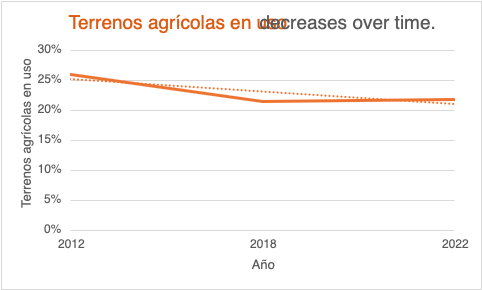
The 2022 Census of Agriculture reports 7,602 farms and 494,481 acres of agricultural land in Puerto Rico (21.9% of the territory). Although the number of farms fell compared to 2018, the total agricultural area increased slightly (≈1.4%), reflecting consolidation and the need for efficiency. This structure pressures the sector to produce more with fewer hands and under greater climate variability, hence the role of agrotechnology to integrate it further into agriculture.
Youth and succession: technology as a gateway
With operators averaging 61 years of age, technological adoption (hydroponics, protected agriculture, precision irrigation, drones for monitoring) makes the work more technical and less physically demanding, increasing its appeal to young people with training in agronomy, mechatronics, or agricultural business. This technological aspect of agriculture is highly attractive to youth. That is why we must continue implementing technology in agriculture to raise the low number of young people entering the sector.
Conclusion
From the machete to the drone is not just a catchphrase: it is a real and measurable change. Hydroponics is already scaling up, greenhouses improve resilience, drones accelerate evaluation and management, and smart irrigation optimizes resources. If Puerto Rico consolidates these paths with education, financing, public policy, and substantial government subsidies, it can produce more steadily, attract young talent, and mitigate vulnerability to climate and external shocks. This is the present and the future we cannot fall behind; we must evolve alongside technology.
The Official Sponsor of this article is:
De Mi Tierra a Mi Pueblo Corp. 🌱 Committed to Agriculture and Food Security in Puerto Rico.
References
- USDA NASS. 2018 Puerto Rico Census of Agriculture – Table 4: Principal Operator Characteristics.
- USDA NASS. 2022 Puerto Rico Census of Agriculture – Highlights.
- USDA NASS. News Release (18 jul 2024) – Resumen de resultados 2022.
- USGS. Effects of Aquifer Development and Changes in Irrigation, Santa Isabel, Puerto Rico.
- USGS. Changing Irrigation Practices, Santa Isabel–Juana Díaz.
- Telemundo PR
- Indoor Ag. Campo Caribe: Transforming Tropical Farming
- Agritecture. How Greenhouses Are Enabling Hurricane-Resilient Farming in Puerto Rico
September 11, 2025
 Economía y Agricultura en Puerto Rico - Eduardo Bonilla