Cost of Living in Puerto Rico: A Comparison with the United States (English Version)

The cost of living in Puerto Rico is a recurring topic due to its implications for the local economy and the quality of life of its residents. This article examines the key factors that determine the cost of living on the island and compares them with high-cost states like California, offering a clear and detailed perspective on this issue.
Current Cost of Living in Puerto Rico
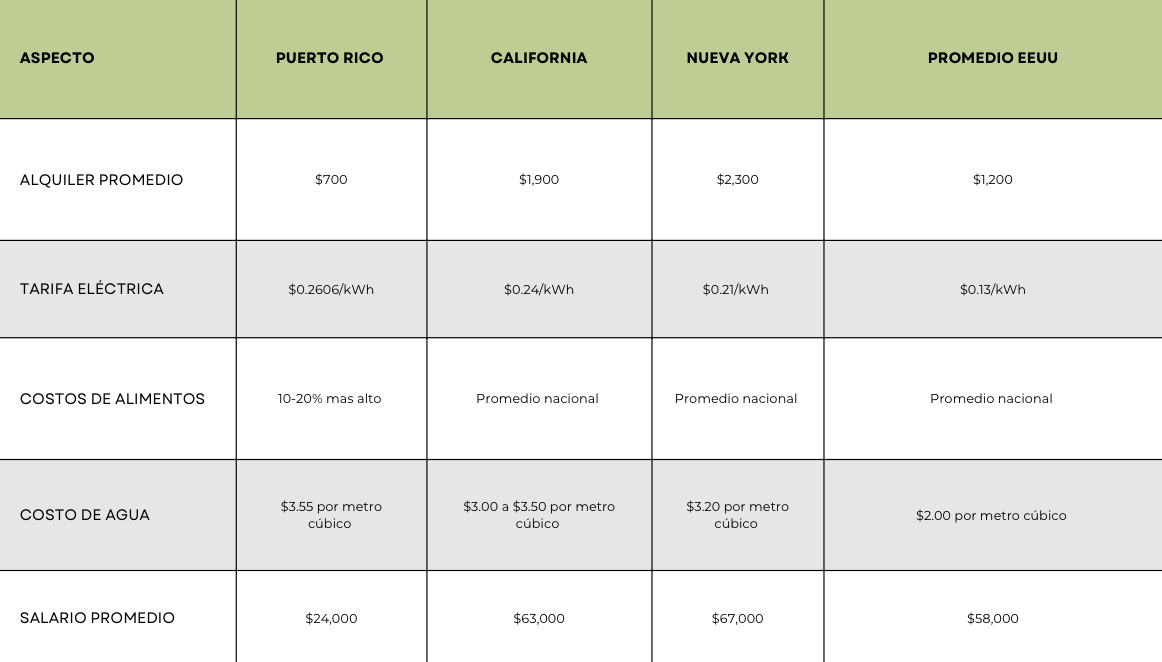
Although living in Puerto Rico may seem more affordable than in some states in the United States, the low wages and high costs of services such as energy and water make it more expensive. Recent data shows:
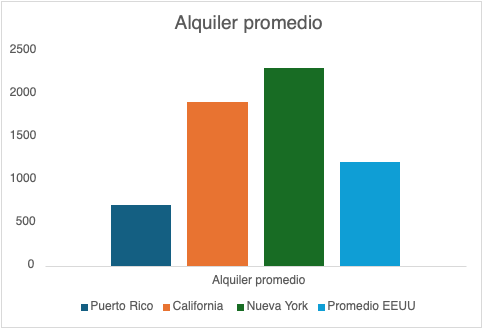
- Rent: The average cost of rent in Puerto Rico is 40% lower than in the United States, taking into account that Puerto Rico has a significantly lower average salary.
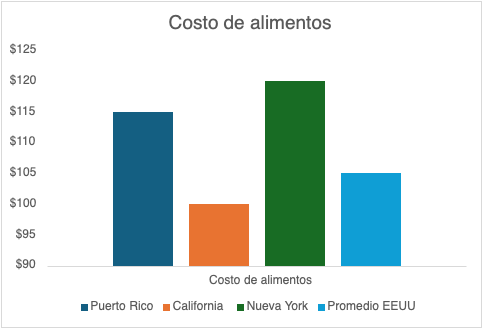
- Food: In Puerto Rico, food costs are 10–20% higher due to the island’s dependence on imports.
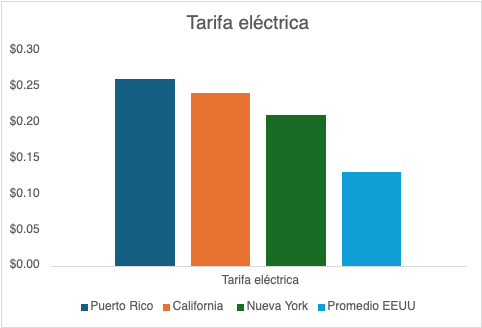
- Energy: Puerto Rico has one of the highest electricity rates in the United States, with a current cost of $0.26038/kWh, representing a 9.5% increase from the previous month ($0.2378/kWh).
- Water: The cost of water in Puerto Rico is quite high compared to the U.S. average, at $3.55 per cubic meter. Additionally, Puerto Rico’s significantly lower average salary ($24,000) compared to the U.S. average ($58,000) makes water less affordable for residents on the island.
These disparities reflect an economy heavily reliant on imports (85%) and facing significant challenges in infrastructure and fiscal policies.
Comparison with High-Cost States:


Comparison Conclusion:
- Considering purchasing power, residents of states like New York and California are in a better financial position despite the high cost of living. In contrast, in Puerto Rico, limited incomes make it difficult to cover basic expenses, including water service, which is 77% more expensive than the U.S. average.
- Although the cost of rent is much lower in Puerto Rico, the average salary is also significantly lower. In New York, for instance, while the cost of living is high, the average salary ($67,000) largely offsets these expenses.
Conclusions
The cost of living in Puerto Rico presents unique challenges due to its 85% reliance on imports, high energy costs, and low wages. However, with economic strategies focused on sustainability and local development, there is potential to improve the quality of life for Puerto Ricans and reduce economic disparities with U.S. states.
This article invites readers to reflect on the importance of efficient public policies and the commitment of all sectors to building a more prosperous and equitable Puerto Rico, where families no longer feel the need to leave the island in search of better opportunities but can instead stay and build their lives here.
This article is presented thanks to the sponsorship of:
De Mi Tierra a Mi Pueblo Corp. 🌱 Comprometidos con la Agricultura y la Seguridad Alimentaria en Puerto Rico.
August 1, 2025
 Economía y Agricultura en Puerto Rico - Eduardo Bonilla